Brussels played host to the TIC Summit 2026, a landmark gathering that brought together senior policymakers, industry leaders and the global Quality Infrastructure community under a single, urgent question: in a world of shifting strategic priorities, redesigned energy systems and increasingly conditional trade, how do we ensure that innovation is trusted? Across a full day of debate — from a high-level expert roundtable in the morning to keynote addresses and policy exchanges in the afternoon — one answer emerged again and again. Innovation becomes transformative only when it is trusted, and the Testing, Inspection and Certification sector is the engine of that trust.
Setting the scene: the Quality Infrastructure Roundtable
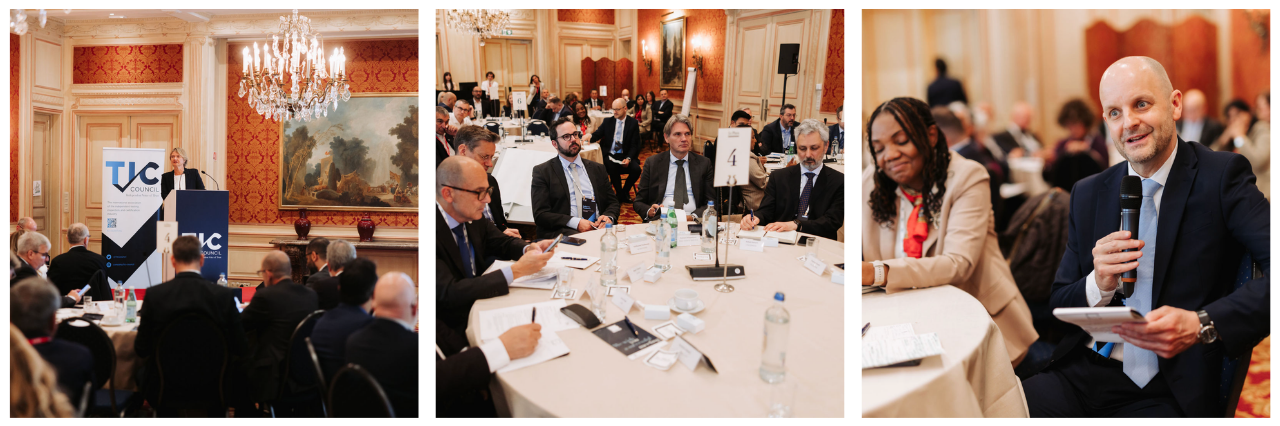
The day opened with the second edition of the TIC Council's high-level QI Roundtable, convening senior leaders from industry, standards organisations, accreditation bodies and conformity assessment under the theme “Industry Resilience in a Fragmented World: What Role for Quality Infrastructure?” The central question on the table was a pointed one: is the current Quality Infrastructure ecosystem, in its existing form, still fit for purpose?
Participants reached broad consensus that today's Quality Infrastructure processes are struggling to keep pace with industrial transformation. Standards development, accreditation convergence and regulatory coordination were all identified as areas where delays and fragmentation are creating barriers for industry. Innovation cycles — particularly in AI and digital technologies — now move significantly faster than the traditional consensus-based systems that Quality Infrastructure was built upon. Yet the discussion equally reaffirmed why that infrastructure matters: it remains the often-invisible system underpinning trust in safety, quality and fairness, and the foundation of confidence in global trade.
Artificial intelligence: challenge and opportunity
Artificial intelligence emerged as one of the dominant themes of the morning. Participants agreed that AI represents both a major challenge and a major opportunity for the Quality Infrastructure ecosystem. While the rapid deployment of AI is generating new demands for standards, conformity assessment and accreditation, AI was also seen as a powerful tool for modernising Quality Infrastructure processes themselves — from standards drafting and conformity assessment support to data management and digital interoperability. The concept of “smart standards” — digitally native, machine-readable standards — was repeatedly highlighted as a long-term direction for the sector.
A call for coordination and visibility
A second recurring message was the need for stronger coordination across the pillars of Quality Infrastructure. Standards bodies, accreditation bodies and conformity assessment organisations too often operate in parallel rather than through genuinely integrated approaches, contributing to duplication, inconsistent interpretation and slower delivery for industry. Participants called for more structured dialogue, shared strategic priorities and greater interoperability at both European and international levels.
Closely linked was a call for the community to communicate its value more effectively. The role of Quality Infrastructure in enabling trust, innovation and competitiveness remains insufficiently understood outside specialist circles, and speakers stressed the importance of building a stronger collective narrative — one that clearly explains how Quality Infrastructure supports economic resilience, market confidence and technological progress. On the European front, the ongoing revision of the EU's New Legislative Framework featured prominently, with the European Commission reinforcing that Quality Infrastructure remains an essential component of Europe's competitiveness agenda and industrial strategy.
Annual General Meeting
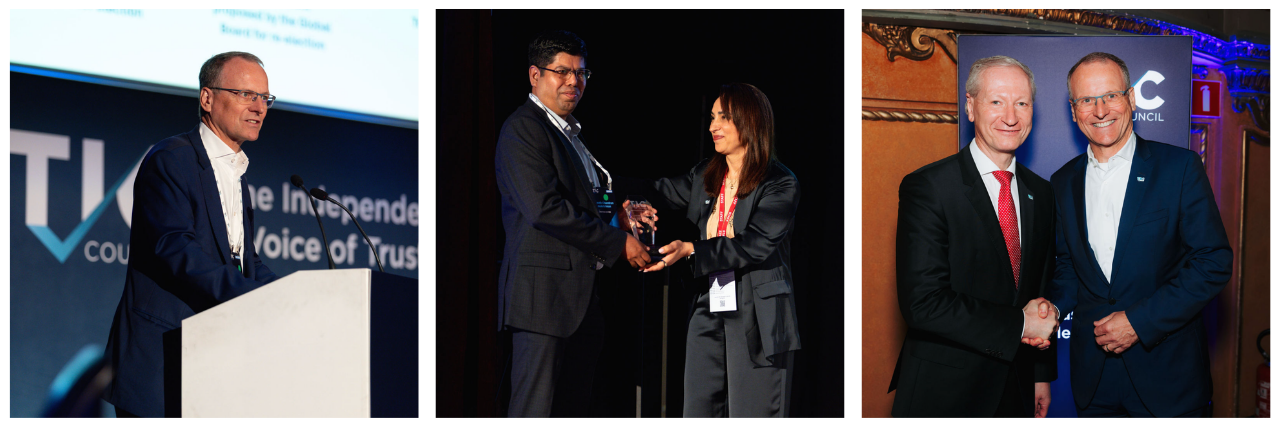
During the Annual General Meeting, the membership approved new members and elected a new Presidential Office to guide TIC Council through its next chapter.
Stefan Haas, CEO of TÜV AUSTRIA, was elected as the new President of TIC Council, succeeding Dr Michael Fübi. Stan Zurkiewicz, CEO of DEKRA, was elected Vice President, while Jennifer Scanlon, CEO of UL Solutions, was re-elected Vice President. Peter Boks, CEO of Saybolt, continues to serve as Treasurer.
The Annual General Meeting also approved the admission of new Full Members joining from 1 June 2026: AGP (Iraq), DNV (Norway), DQS (Germany), ECOCERT (France), Mats India (India) and T-ALL (China). In addition, NFPA Global Solutions (USA) was approved as a new Associated Member.
The meetings also provided an opportunity to look ahead to the priorities that will shape TIC Council’s work in the years ahead — promoting trust, safety and innovation across the global TIC sector as the industry navigates reindustrialisation, digital transformation and an evolving regulatory landscape.
As part of the Annual General Meeting, TIC Council also presented its annual Merit Awards, recognising individuals who have made an outstanding contribution to the TIC community and to the advancement of the sector worldwide.
This year’s Merit Award winners were:
- Mark Quillinan (Alfred H Knight) — Advocacy Award
- Sarath Chandran Ramakrishnan (RSJ Inspection®) — Reputation Award
- Stefanie Vehring (TÜV SÜD) — Promotion of Best Practices Award
- James Armstrong, CHSO, CSM, CEM, GSM (AmSpec Group) — Hand on the Tiller Award
The Summit opens
With the morning's groundwork laid, TIC Council Director General Hanane Taidi opened the Summit proper, framing the stakes for the afternoon: how Europe can rebuild industrial capacity while staying globally competitive; what must align for trade to function across divergent regulatory systems; how the energy transition and digital technologies can scale safely and credibly; and why testing, inspection and certification are strategic enablers of investment and market access.
Keynote: Dr Bertrand Piccard on trusted innovation
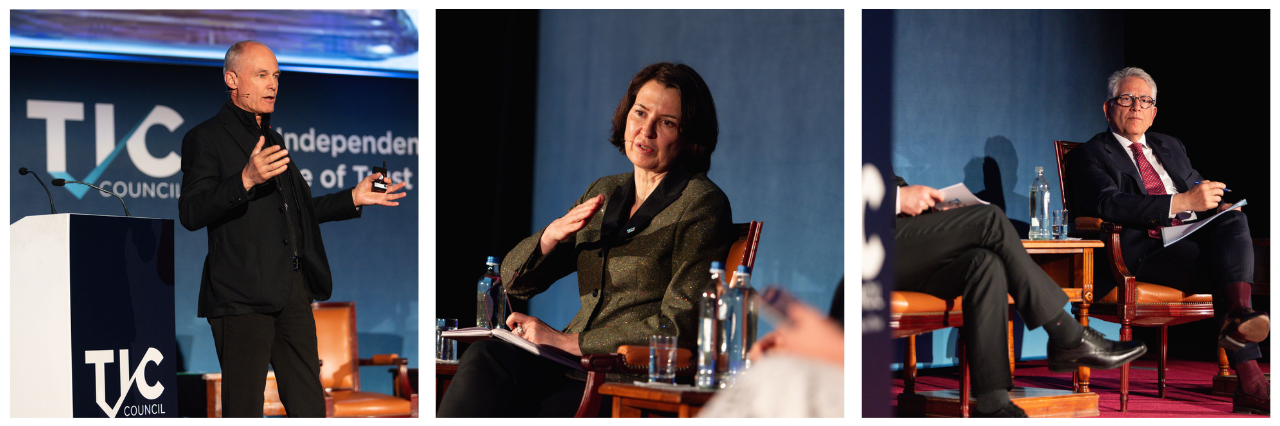
Pioneering aviator, explorer and clean-technology champion Dr Bertrand Piccard took the stage to present Climate Impulse, his latest flagship initiative demonstrating how breakthrough climate solutions can be deployed at industrial scale. His message resonated with the day's central theme: from solar aviation to clean energy systems, pioneering technologies move from ambition to industrial reality only when their safety, reliability and performance are independently verified — a powerful reminder of why the TIC sector sits at the heart of the green and industrial transition. The keynote was sponsored by Seamflow.
In a fireside chat that followed, moderated by journalist Jennifer Baker, Dr Piccard was joined by Géraldine Picaud, CEO of SGS, to connect visionary leadership to industrial reality — exploring how trade, productivity and governance shape resilient value chains, what businesses need to invest with confidence, and how companies operating across borders manage compliance, trust and market access.
Europe's industrial direction and the CBAM debate
The policy programme brought Europe's reindustrialisation into sharp focus. A high-level address from the European Commission, delivered by Emanuele Tarantino, set out how Europe can strengthen its competitiveness while remaining open, sustainable and secure — rebuilding industrial capacity without retreating from the global stage, and positioning Quality Infrastructure within that strategy.
Gerassimos Thomas, Director General of DG TAXUD at the European Commission, then explored how the Carbon Border Adjustment Mechanism is reshaping global trade, in conversation with Dr Stefan Haas and Jennifer Baker. As market access increasingly depends on demonstrating carbon performance and compliance, the message was clear: trust is the critical enabler of the transition. Carbon data must be measurable, comparable and independently verified to be meaningful across jurisdictions — making Quality Infrastructure essential to ensuring carbon markets function effectively, support fair competition and enable scalable, credible decarbonisation.
Closing the day
Drawing the threads together, TIC Council President Dr Stefan Haas reflected on a day that ranged from bold keynotes to high-level policy debate. One theme ran through all of it: innovation becomes transformative when it is trusted. From reindustrialisation to climate ambition, and from CBAM to digital transformation, the TIC sector is not a footnote to the industrial transition — it is a strategic enabler. As the formal programme gave way to a networking dinner, the message to the sector was that the conversations would continue, online and across the community.